
The History of Hughson Hall
John Sharman was one of Stratford’s first of three pioneers and founding families emigrating from Telford, Bedfordshire, England in 1834 where he was a blacksmith and at which time the population of Stratford was thirty-nine. He was invited to emigrate in the summer of 1833 by his good friend, John C. W. Daly, who had come to Stratford the year before and who had realized this burgeoning locale urgently needed a blacksmith. John Sharman was the first blacksmith to arrive in the fledgling village and he was therefore destined to become a very important member of the community. John Sharman arrived in 1834 with his wife Lydia (Brown), and they built a house on a lot near where the Lion’s swimming pool is today. Lydia died in 1841 a few years after their arrival. Some historians believe she was the first person to die in the new settlement. She was the first person to be buried in what is known as God’s Acre next to St. James Anglican Church at the end of Hibernia Street although the exact location of her grave has been lost. John’s wife was a school teacher and church organist.
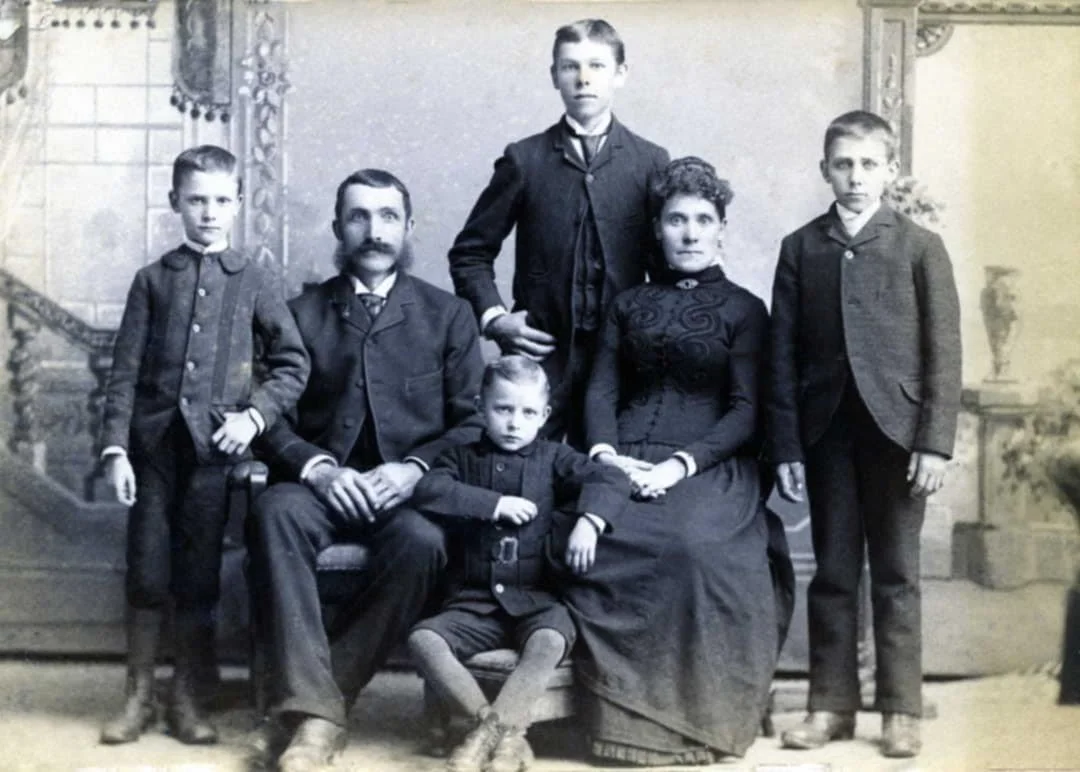
The Sharman family. John and Isabella (Gibb) with their four oldest sons. Joseph at the top center.
Later, John married Isabella Gibb. They were the parents of 7 sons and a daughter. John’s first son, Joseph, was born on August 10, 1841, and was considered to be the first child born in Stratford followed by 6 brothers and a baby sister, Sarah, who only lived for 5 months. Two sons, Henry and Charles also died as infants.
Joseph was born and Sharman’s blacksmith business quickly prospered, not only because horses and oxen needed to be shod, but also in response to the demand for nails, tools and other supplies needed for the building of the new settlement. The Sharman blacksmith business led to the establishment of the settlement’s first foundry on Birmingham Street opposite St. Patrick Street. The family business prospered with its manufacture of machines, such as The Little Giant Thresher, and other equipment that farmers used to plant and harvest their crops. The Little Giant Thresher was powered by a three-horse treadmill. The family business was called the Sharman and Foster Manufacturing Company. Joseph became Deputy Crown Lands Agent served on both the Perth and County and Stratford municipal councils and, with his brothers James and John, managed and operated the foundry and agricultural implements manufacturing businesses. Joseph was also the land surveyor for the Canada Company. He was soon able to purchase additional land, including farm properties in adjoining Downie Township. He also built a hotel and purchased several lots and choice farm land north of Hibernia Street and East of Huntingdon Avenue which is now part of the local Agricultural Fairgrounds.
In 1863 - Joseph began business as an Iron Founder and Manufacturer of Agricultural implements including the well-known Sharman Threshing Machine.
Joseph and Isabella had eleven children, most of whom were ambitious, successful adults who were definitely not afraid of moving to new provinces, cities, or countries.
1865 – 1953 - Birth of Henry Burton Sharman, firstborn of eleven children of Joseph and Isabella Sharman. Henry, the grandson of John Sharman received his early education in the public schools of Stratford, and in 1882, at seventeen years of age, went west for the summer to work on land acquired by his uncle near the Souris River. Enroute, he gained useful experience by caring for cattle on the train and learned still more by the work of the summer. On his return, he entered the Ontario Agricultural College at Guelph, registering in Animal Husbandry. Two years later he received an associate diploma and the silver medal for highest standing in Animal Husbandry and Veterinary Science. His education was interrupted at that point by family responsibilities. He was sent by his father, joseph Sharman, to England to import Herford cattle for the government. During the ensuing year He worked as a bookkeeper in the family foundry, and probably continued his studies. In that year an event occurred which was ultimately to change the course of his life.
In 1884 the Rev. H.T. Crossley, an evangelist who was particularly effective in his appeal to young people, came to Stratford. Though he had been brought up in a very devout family, Henry had become an agnostic, unable to reconcile his early training with the claims of science. He went, finally to a meeting, but to sit in the gallery intending, if opportunity came, to challenge the evangelist. He found their positions reversed.. Before the night ended, he was a changed man; he had dedicated his will to the will of God.
The actual circumstances are not known, save that it was for financial reasons and family responsibilities that Henry Sharman went west for three years to farm a large tract of unsettled land in the Birdtail Creek area of northwest Manitoba, which had been purchased by this father. The family moved to the farm during those years and in 1888-89 Henry attended the Normal School in Winnipeg, receiving a first-class teacher’s certificate. He taught for one year at Birtle Manitoba. Re-entering the Agricultural College at Guelph in the autumn, he was appointed Supervising Assistant in Chemistry and graduated at the end of the term with the degree of Bachelor of Science in Agriculture. For the next two years he was an Instructor in Chemistry at Guelph.
Already a thorough student, he began to develop his own methods of biblical study and research. Having experienced such depth of meaning in one saying of Jesus, he went on and on, eager not only for himself but very much in earnest in helping others to find what he had found. In personal contacts with his friends and in the life of the Church he became a leader. He had a natural aptitude for teaching and soon began to lead classes in Bible study. He was a doctor of philosophy and New Testament scholar, who by 1930 had moved permanently to Pennsylvania to teach at a college, eventually retiring to California, where he died. His wife, Abbie Lyon, was a writer and biographer.
1867-1943 – George Christopherson became a railway conductor in Missouri and Iowa, living his final days in California.
1869-1899 – John Howard became a dentist. He died in a boating accident in 1899 in Manitoba.
1871-1949 – Isabella Josephine Maude was a school teacher when young, eventually marrying A.R. Tingley, a police magistrate and barrister in Regina.
1875-1911 – Frederick Joseph became a dentist, living in Chicago.
1876-1949 – Charles Rose served in WW1 , eventually moving to Calgary where he was a clerk.
1878-? – Edward Dufferin became a homesteader in Saskatchewan. Later in life he worked as a car repairer in Winnipeg.
1879-1949 – Sara “Sally” Wilson lived in Regina, married to an editor who later became a commissioner with the Red Cross.
1881-1980 – Annis Alexina married a journalist and ended up in Regina.
1883-1967 – Jessie Eleanor married a physician, living first in Manitoba and then in Regina.
1884-1970 -William James received his medical degree and eventually opened a bacteriology laboratory in Winnipeg specializing in venereal disease.
1873 - Joseph bought a 75-acre farm lying north of Hibernia Street from his brothers Robert and John Sharman jr. for $4500.00.
1875 – 1894 Joseph built what is now known as Hughson Hall for $4000.00. Joseph was 34 at the time. This home was considered to be one of Stratford’s finest homes and was described as a white triple-brick Victorian Italianate house. Joseph and his wife Isabella (nee Logan) they already had seven children. They eventually had eleven children. The assessments also note the presence of 1 dog, 4 horses, 2 cows and 4 pigs on the farm. The architectural design for the house can be attributed to Alexander Hepburn who specialized in Victorian Italianate houses. The house was built under the guidelines of “Picturesque Theory ”In this field of thought a house should blend into the natural landscape, it should feature irregular or rugged outlines and should look or be old and finally there should be an element of deception or surprise. Hepburn also designed the Windsor Hotel, now known as the Ponderosa or Douglas estate, and the Huron Street Bridge, which is one of Ontario’s few surviving stone bridges. Hisson Thomas also became an architect and built the local Library and Archives building.